RadiantIQ's Finance Play: A CFO's Ultimate Solar Weapon!
March 16, 2026
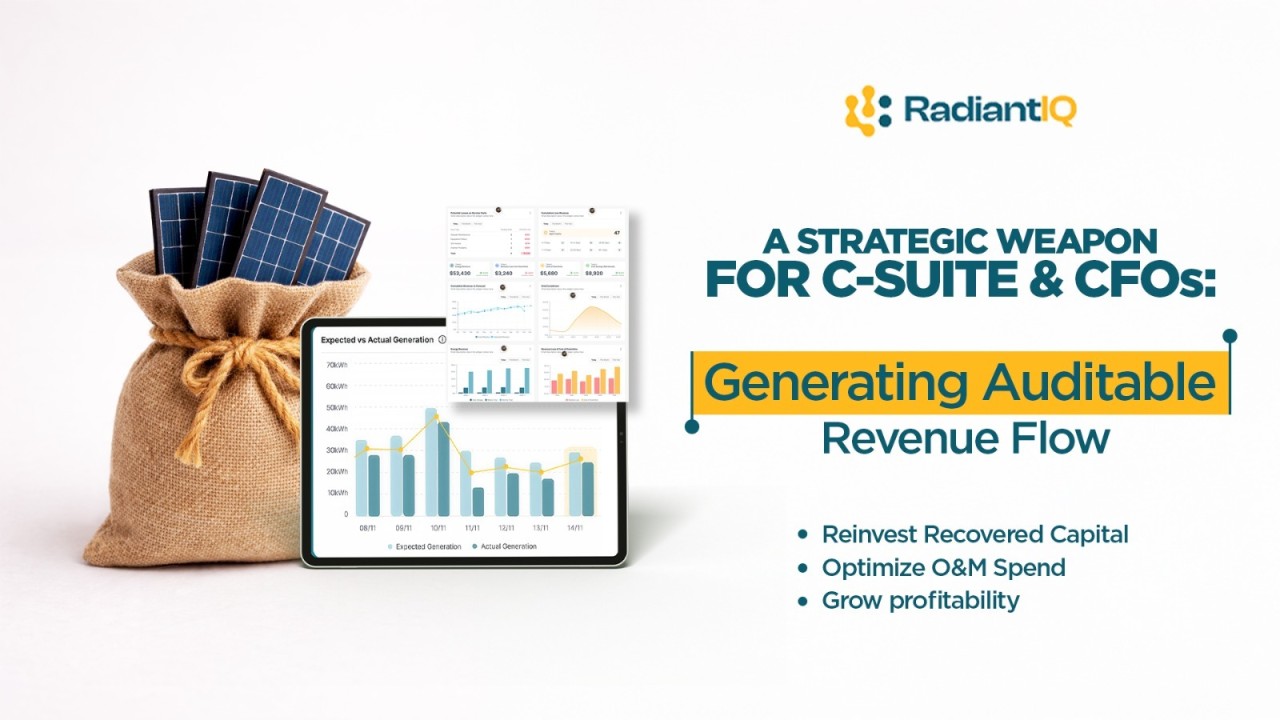
A solar portfolio is a capital investment that must hit specific yield targets, which is why monitoring kilowatts are no longer enough.
"Inverter Brand Lock", where different inverter brands require separate, siloed monitoring tools, obscures the true financial health. RadiantIQ's Inverter Agnostic architecture consolidates these silos into a single, auditable financial truth.
Our latest Finance dashboard makes CFOs, CEOs, and COOs salivate at the financial clarity provided. To maximize the lifecycle of a solar asset, you must monitor the rupees. As shown below, the delta between "Expected Revenue" ($3,800) and "Actual Revenue" ($2,400) isn't just a number: it's a diagnostic signal for site health.
Turning Data into Business Growth
When asset owners can visualize a Revenue Variance in real-time, they shift from reactive repair to strategic growth. RadiantIQ's platform uses Pattern Recognition to categorize losses, whether it's an inverter problem costing $395 or a grid issue draining $210. By identifying these "Lost Revenue" leaks within an hour, businesses can:
- Reinvest Recovered Capital: Minimizing the "Cost of Downtime" (currently $5,680 in our sample data) directly improves the bottom line.
- Optimize O&M Spend: Prioritize service visits based on the highest financial impact, ensuring every maintenance dollar drives ROI.
- Grow profitability: Maximize revenue, generation, and plant uptime by identifying and rectifying alarms and plant interruptions with speed.
A Unified Platform for All Stakeholders
The platform is a strategic weapon for businesses, as it has been designed for Maintenance, O&M teams, Engineers, Finance, Sustainability & C-Suite. Enabling wider stakeholder adoption to leverage your energy asset as a growth lever for strategic planning and operational optimization.
- CFOs/C-Suite: Analyze and compute periodical site performance, ROI, and revenue generation for long-term strategic planning.
- Asset Managers: Track "Cumulative Revenue vs. Forecast" to ensure long-term financial targets are met.
- O&M Teams/Engineering: Use "Aged Tickets" and "Potential Losses" to streamline workflow efficiency.
- Sustainability teams: Access monetized "CO2 Savings" for auditable, boardroom-ready sustainability reporting.
An Early Financial Warning System
A revenue Variance of -$700 is an immediate red flag. While traditional O&M might take days to notice a string failure, our AI Anomaly Detection identifies the gap between Expected Revenue ($3.8K) and Actual Revenue ($2.4K) within the hour. For a CFO, this means minimizing "Lost Revenue" before it compounds into a monthly deficit.
Monetizing Downtime & Aged Tickets
The Cumulative Loss Revenue widget provides a breakdown that is essential for a CFO's risk assessment. By categorizing losses—such as $450 from Equipment Failure or $395 from Inverter Problems—management can hold O&M teams accountable. 47 aged tickets tell a CEO that operational friction exists.
The Cost Of Suboptimal O&M Teams
We quantify the exact dollar impact of system interruptions ($5,680), allowing you to calculate the precise ROI of increasing maintenance headcount or upgrading hardware, and working with quality service providers.
ESG Monetization: Boardroom-Ready Data
Sustainability is no longer a "soft" metric. RadiantIQ monetizes CO2 Savings ($8,920), converting environmental impact into a financial asset. This provides CFOs with auditable data for ESG Compliance and carbon tracking, simplifying reporting under ISO/SOC 2 standards.
The ultimate strategic weapon
Strategic Growth via Predictive Analytics helps analyze the Cumulative Revenue vs. Forecast. Leadership can determine if a site is underperforming due to degradation or external factors like grid curtailment. This high-level visibility allows for Better Capital Allocation, Portfolio Scalability, and Strategic pivots.
By bridging the gap between technical performance and financial integrity, RadiantIQ ensures your solar portfolio remains a high-performing financial asset, not just a hardware installation which is periodically maintained.